How to Choose a Shower Chair for Elderly Users
The CDC reports that more than 1 in 4 adults over 65 falls each year, and bathroom injuries among seniors occur at 8.2 times the rate of adults 25-64. A shower chair is the single most specified piece of equipment for reducing that risk — but the chair has to fit the user, the bathroom and the freight plan. This guide covers what to check before placing an order, written for distributors, care-home procurement teams and pharmacy program buyers sourcing from a factory.
The Four Numbers That Decide the Order
Four measurements decide whether a shower chair works in the room it is bought for. Get them wrong and the chair is returned, not used.
Overall width. This is the door-and-enclosure number. A chair 77 cm wide does not go into a narrow bathroom stall, and it does not go into a bath tub at all — it sits on the shower floor or beside the tub. Measure the narrowest opening on the route before ordering, not the room. A transfer bench or an over-rim model is a different product entirely.
Seat height. This is a transfer-safety number, not a comfort preference. A seat that sits lower than the bed or the toilet turns every transfer into a descent; a seat that sits higher turns it into a climb. The right height puts the user's knees close to a right angle when seated, which typically falls between 39 and 53 cm depending on the user. Fixed-height chairs are simpler and cheaper; adjustable-height chairs cover a range of users but cost more and have more parts to fail.
Weight rating. 100 kg (220 lb) is the industry standard for a folding aluminum shower chair; heavier users need a reinforced frame quoted as a separate build. Read the rating as a tested maximum, not a comfort figure — a padded number gets asked for its test report and does not survive a tender.
Folded width. If the chair is stored between uses — behind a door, in a cupboard, in the boot of a family car — folded width is the number that decides whether it gets put away or left in the shower. Folding aluminum chairs typically fold to 22-24 cm.
Shower Chair, Shower Commode Chair, or Transfer Bench: Which Product
Three products get sold under the same category, and ordering the wrong one is the most common return in bathroom safety equipment.
A shower chair is a seat in a shower. It has a drainage seat (water runs through, not pooling under the user), a backrest, non-slip ferrules on the legs, and no commode function. It is for a user who walks to the shower, sits to wash, and walks back.
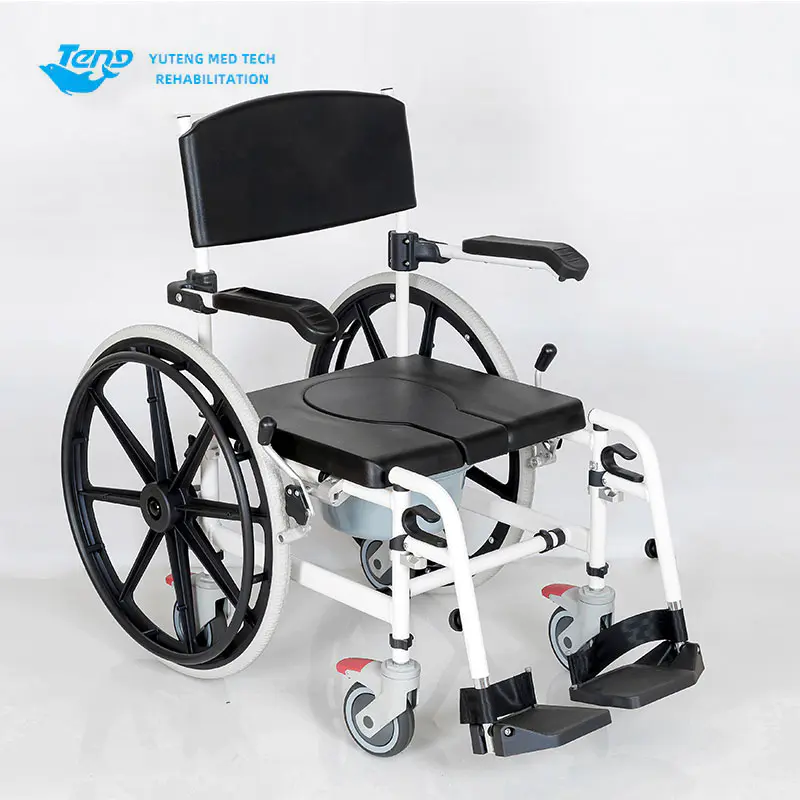
A shower commode chair adds a sealed aperture in the seat with a removable pan underneath, so the user is washed and toileted in the same chair. This is the model specified for users who cannot transfer to a toilet, and it lives in the wet room full time.
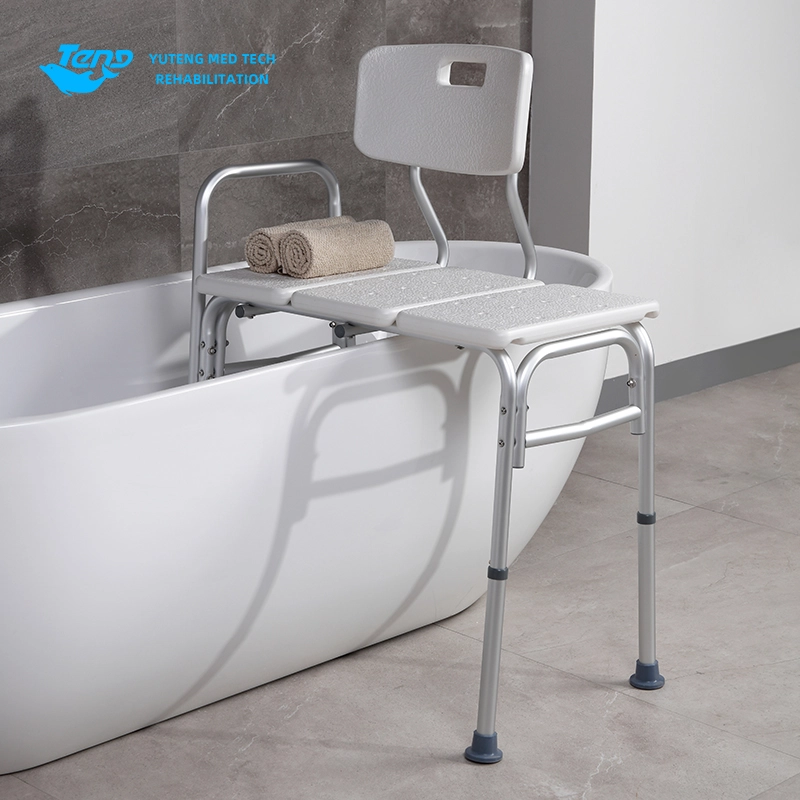
A transfer bench spans the side of a bath tub — two legs inside, two outside — so the user slides across the rim instead of stepping over it. We do not build this product; if your program needs it, tell us the requirement and we will confirm what is available rather than quote the wrong model.
Arms or No Arms: the Specification That Prevents Wrong Orders
This is the single most common ordering mistake, and it happens because the specification sounds trivial until someone tries to stand up from a wet seat.
Armrests are what most users push against to stand. A chair with arms helps a user who is steady enough to rise with support but not to rise from a flat seat. A chair without arms lets a caregiver assist from the side and is slimmer to move and store. Neither is universally correct — the choice follows the user's transfer ability.
The problem at procurement level: a dealer who assumes all shower chairs have arms and orders a container of armless frames will receive returns, not sales. Check the specification sheet before the order, not after the sample. On factory-direct orders, armrests are a different mould and are quoted as a separate model — not as a modification of an armless chair.
Aluminum vs Steel: What the Frame Material Actually Buys
The choice is not just weight — it is what fails and when.
Aluminum (typically 4-7 kg for a folding shower chair) does not rust. On a product that is wet several times a day and air-dried, the failure mode is corrosion at the joints, not the tube wall — and aluminum eliminates it. A well-built aluminum frame that comes out of a shower every day for five years is still the frame you bought. The trade is cost: aluminum is more expensive per unit.
Steel (typically 7-16 kg) is cheaper and harder to dent. Chrome-plated steel survives a care-home environment where the chair is knocked against door frames, loaded into vans and wiped down between users. The failure mode is rust at the joints after repeated exposure, which is why steel models are often specified for dry-room use or short-term loan rather than full-time wet-room duty.
For a program that specifies one chair per user and keeps it in the bathroom, aluminum is the longer-lived choice. For a loaner pool that cycles chairs between users and rooms, steel is more forgiving.
Six Safety Features to Check on Any Quote
- Drainage seat. Water must run through, not pool. A seat with no drainage holes is a slip risk, not a shower chair.
- Non-slip ferrules. Rubber feet with a tread pattern, sized to grip tile and vinyl. Check the replacement part is available separately — ferrules wear out before the frame does.
- Backrest height. Tall enough to support the back, not just the pelvis. 40 cm or above from the seat is the range where a user can lean back and relax rather than holding themselves upright.
- Locking mechanism on adjustable legs. If the legs adjust for height, check that the lock is a push-button or a clamp that holds under a wet load. Friction collars slip when wet.
- Certification set. ISO 13485 (quality system), CE (Europe), FDA establishment registration (US). TUV test reports on request. A tender will ask; the quotation should already have them.
- Carton dimensions. The buyer who forgets this cannot plan freight. A folding aluminum chair typically packs at 80 × 22 × 45 cm with 2 units per carton.
Ordering from a Factory: MOQ, Lead Time and Container Math
There is no fixed MOQ — trial orders and sample-based programs are normal. Lead time is 40-50 days from deposit, and capacity across the range is 1,000+ sets a month.
For freight planning: a folding aluminum shower chair at 4.68 kg ships 2 per carton at 0.0792 m³, which works out to roughly 1,500-1,700 units per 40HQ. At that count the load is under 8,000 kg — far below container payload — so this is a volume-limited product and the carton count is what your forwarder needs. A mixed container with commode chairs and rollators is routine and calculated per order.
For OEM orders, send the destination market, the seat height range and the color. Branding and packaging involve no tooling; a frame or seat-width change is a development project quoted separately. Tell us the certification your customs will ask for and the documents travel with the quotation.
Frequently Asked Questions
What is the best shower chair for elderly users?
A folding aluminum chair rated 100 kg with a drainage seat and a backrest. Aluminum does not rust, the fold makes it transportable, and 100 kg covers the large majority of adult users. See our folding aluminum shower chair for the full specification.
What height should a shower chair be?
Set the seat so the user's knees are close to a right angle when seated. For most adults this falls between 39 and 53 cm. Fixed-height chairs are simpler and more durable; adjustable-height chairs cover multiple users.
How much weight can a shower chair hold?
100 kg (220 lb) is the industry standard for a folding aluminum model. Heavier users need a reinforced frame — tell us the target rating and it is quoted as a separate build.
Does a shower chair need armrests?
It depends on the user's transfer ability. Arms help a user who pushes to stand; no arms lets a caregiver assist from the side and makes the frame slimmer to store. Neither is universally correct — check before ordering.
What is the difference between a shower chair and a shower commode chair?
A shower chair is a seat in a shower. A shower commode chair adds a sealed aperture with a removable pan, so the user is washed and toileted in the same chair. See our shower commode chair for that model.